Pages

Showing posts with label Life. Show all posts

25 June 2010

Last week, the evening before an important business meeting, I tired of thinking about doing any further prep work for a presentation that wasn't likely to assist in maintaining my job past an upcoming merger. So, what to do, when one is in New York, doesn't have room in luggage to carry home lots of books, and hasn't scored tickets to Shakespeare in the Park in the virtual raffle: find a play with affordable tickets 20 minutes before the current rises. My choice: Nora & Delia Ephron's Love, Loss, and What I Wore.

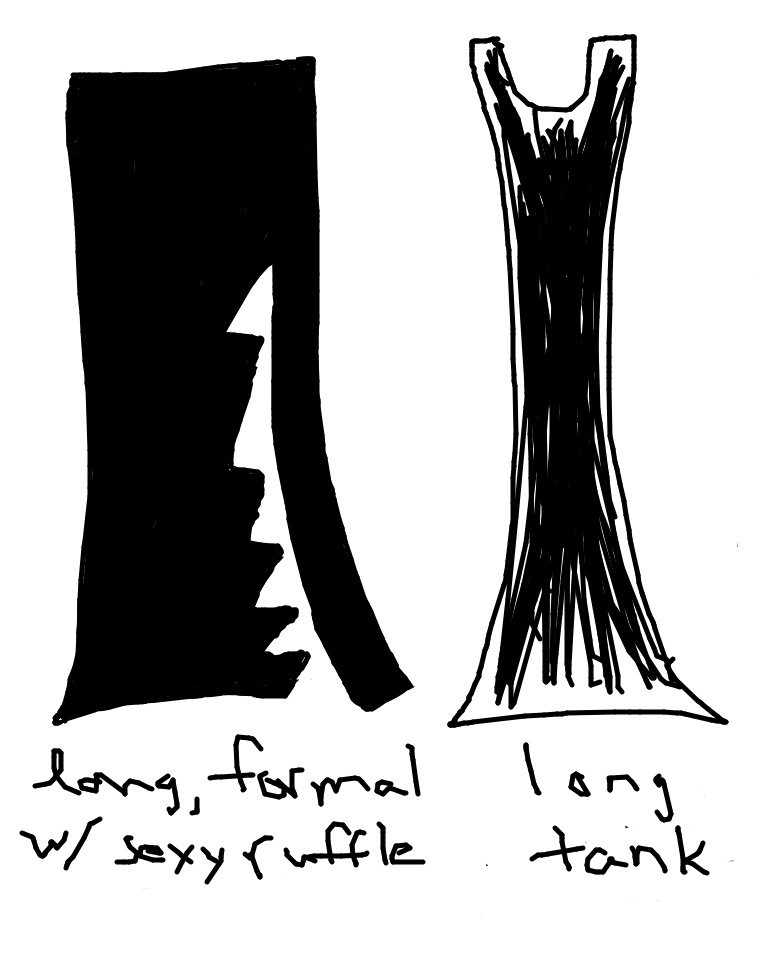
The play, really a reading of several monologues by five actors, had some funny lines but dealt with a predictable catalog of "women's" issues surrounding careers, marriages, children, and health, divorce and death. While I enjoyed my evening, I not likely to remember much from the play in a week. But, later that evening, when I was unable to fall asleep, I decided to try to draw some examples from my own wardrobe over the years. What works as a device in the play, similarly, provoked me into thinking about various episodes in my life.

I'm not skilled at drawing, but voila! It is what it is.

As an adult, I came across a photo my father had shot one Easter morning.   Alongside my 3 sisters, I sat on the porch, posed for the camera.  We all were in brand new dresses and shiny patent leather shoes, with matching hats:  four little ladies -- almost. From left to right, Michele, Helene, & Patrice sat primly, smiling, legs crossed demurely, their hats seated jauntily atop neatly brushed curls.  At the end of the row was me:  knees apart, dress rumpled and grass-stained, socks fallen, mud-covered shoes, straggly hair, hat in hand, unable to hide the fact that no amount of AquaNet could keep the curls from fleeing as soon as I went outside.  
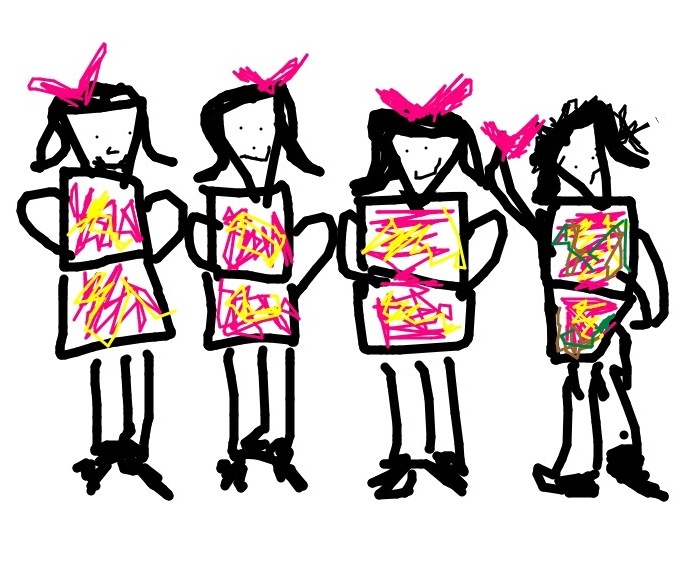

 I suspect I never saw this picture when a child because my mother was aghast when she saw it.  Many of the pictures from my childhood were similar.   I knew from an early age that I didn't have a career in modeling ahead of me.

One of my favorite dresses when I was 6. It's was a hand-me-down and you can find a picture of the real dress in an earlier post.   I felt like a princess in this dress, the green velvet vest the most luxurious item I owned.  I thought I was beautiful! I wore it for every holiday for a few years, long past a proper fit.


It was certainly different than the scratchy wool uniforms we wore to school: Red plaid, white blouse with peter pan collar, navy blue tie, navy blue socks, serious looking shoes. I think they were saddle shoes, before those became retro and cool.   We drew bell bottoms & flower power signs in our notebooks -- the closest we could get to dressing how we wished.   Just before the start of the school year, all the moms would gather in the gym for a uniform exchange.   For some girls the jumpers were too big at the start of the year.  For petite me, they were too big and too long all year. There wasn't a chance in the world that I would ever fail the nuns' random tests to be sure that your skirt was only so many inches from the floor when you knelt.  I detested the color red for years.
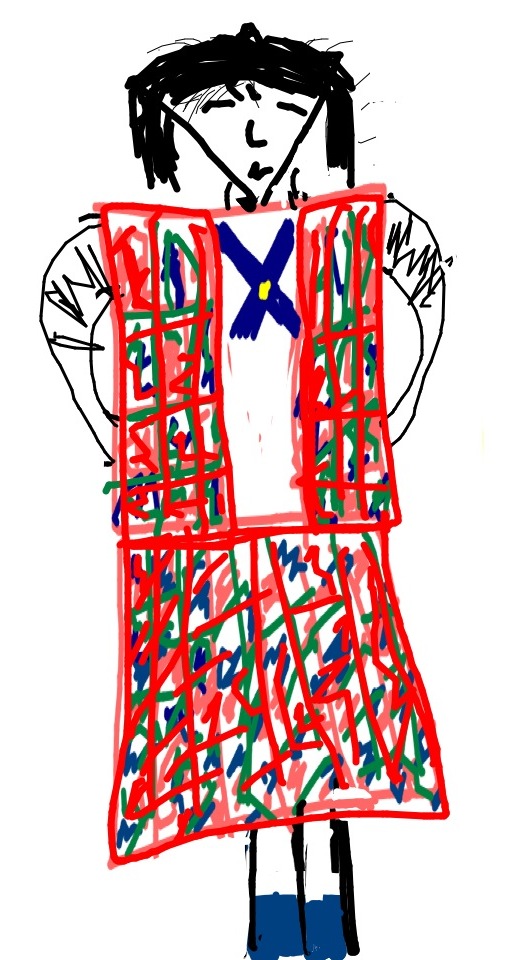

In Jr. High, my parents' placed me in a public school.   Nobody knows me, I thought.  Here's my chance of being cool.   That lasted until my mother came home one day with my new school clothes.   She also had a special surprise:  she had my sister sew an outfit -- a pantssuit, with bellbottoms! -- for me.   Nearly 40 years later, I still don't know what she was thinking  and wonder if my sister really hated me that much: 


Red and mustard colored paisleys on a sea of brown. Brushed velvet. Pants and vest, worn with a bright yellow blouse. I think the idea behind the vest was to hide my blossoming bosom.   My hopes for being considered cool were gone before I got on the bus.  Years ago, when I taught school, I thought that the years between 12 - 15 were like walking down the school hallways naked, one's emotions so exposed , a chronic state of being self-conscious.   And then I think about the 7th Grade Pantsuit.   Naked would have been better.  

I still feel horrible if I wear yellow.  

At the start of 8th grade, I told me mother that The Pants Suit didn't fit me any more. It stayed in the back of the closet until it found its way into a GoodWill bag, with the aid of a younger sister who would have received it as a hand-me-down. My clothes weren't more hip, though I did have Five Minutes of Sartorial Fame in 8th grade during a 50's Day contest.   Happy Days was the new rage, and somehow dressing up in our parents old clothes was suppose to show our school spirit.   I was never much for those types of events, but I decided to wear one of my mother's dresses.  While every one else was dressing in poodle skirts or leather jackets & rolled up jeans to look like Erin, Richie or The Fonz, I wore my mother's "Going Away" dress, the dress she wore when she & my father left for their honeymoon.   I thought the deep purple, ribbed knit dress was lovely.  It had sparkling rhinestone buttons and a short matching sweater.  I wore my mother's matching pumps, the highest heels I had ever worn.   With an china pencil, I drew seams on the back of my hose.    To complete the June Cleaver look, I wore my mother's pearls and my Grandmother's fox stole, complete with --shudder -- feet.  I think my school might have had Tim Gunn's soulmate on the staff:   I won the faculty award for best dressed and was given the title The Queen of the 50's.  
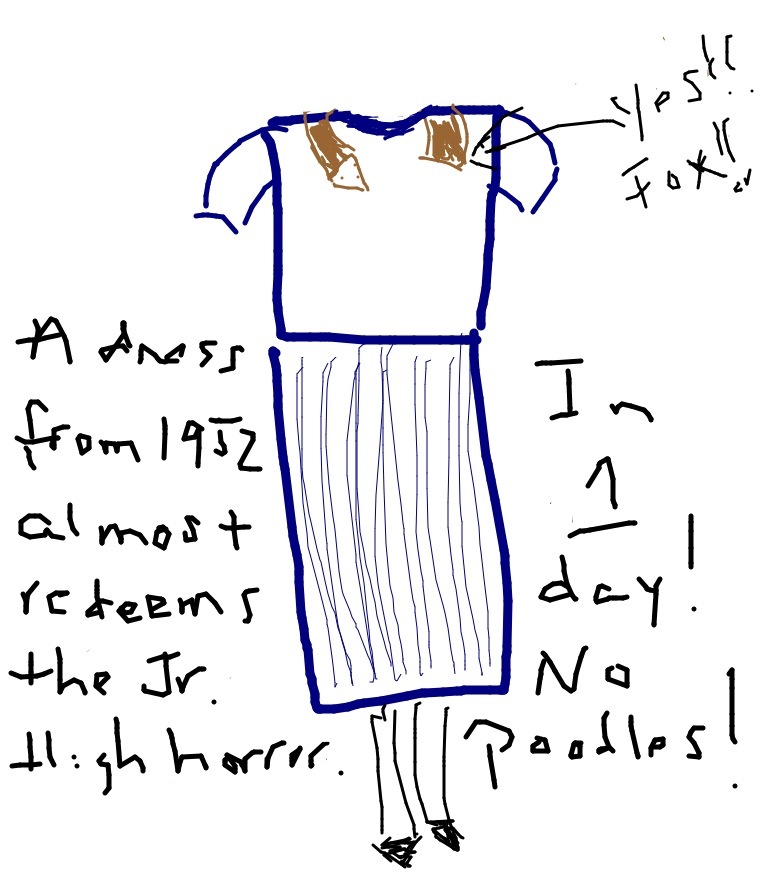

More fun than actually winning, was the taunting I received from the popular mean girl who thought that she would win with the custom-designed poodle skirt her mother had made for the day. I can still hear her saying: You really shouldn't have won; I gave the idea for the contest to Student Council and I was supposed to win.  You were suppposed to dress, like, you know, a KID from the 50's, not somebody's MOM from the 50's!

I started my first post-college job in the early 80's.  Like everyone else, I wore serious looking suits, which meant that they looked like men's suits, with big shoulder pads.  And silk ties, tied in neat little bows, to look feminine.  Yeah, um, no.   I'm hopeful that look is never revived. 

I started branching out a little in the late eighties, wearing dresses, even though we were told it was very MidWestern, and not very chic.  

I had a teal skirt and blouse, that looked like a dress, that I thought looked really great. 

And a more "professional" looking dress.   Why more professional?   Probably the damn bow.  It took me a dozen years to realize that I look good in Red.


Eventually I moved away from the bows, and thought I was daring if I showed any cleavage, like the pink & blue dress that I was wearing when I met my first husband.   He invited me to a Halloween party the next weekend, although it was actually the weekend after Halloween. I wore green pants and sweater strung with christmas lights and candy canes.   This was before there were battery operated lights, so I had to plug myself into a wall socket so that people knew I was a Christmas Tree. I got lost on the way to the party and had to stop for directions.  They might have been tempted to direct me back to the insane asylum.  I later thought of this as the Nightmare Before Christmas Costume


As I moved into middle age, my wardrobe became more monotone.  While there was the occassional purchase of something really awesome, like the Beautiful Green Suit, made from a brocade like fabric with small gold buttons,

mostly my closet reflected only one color:  Black. 


My husband once asked me why I needed 7 black skirts/dresses. Just because they are the same color, they are not alike. Since I know he knows how to count, some of them must look the same to him.


And, of course, the LBD:


These days, I work in an office with a casual dress code. 


It's casual, not business casual.   I could probably show up wearing exercise cloths.   If I did, they would be black.

26 September 2009

Suggestions?

One has 4 days in NYC, Fri - Mon. Already scheduled: Play Sat Evening (Hamlet), musical on Sunday afternoon (South Pacific), and the Met Opera on Monday evening (Le Nozze de Figaro). What are your suggestions to fill my days?

Please note, the following are not on any list that will be considered: Empire State building (unless it is to laugh at the fools who take video pictures of a stationary building. It doesn't move, people!), Statute of Liberty, the Circle Cruise, staring at the empty pit that was WTC (I've taken the PATH too many times and it always saddens me to see it), eating overpriced oysters at Grand Central Station, congregating at Rockefeller Plaza during the Today Show, seeing real buildings where fake people supposedly lived (cf. Sex & the City tour), touring the Intrepid or strolling purposelessly through the blaring, sense-numbing, migraine-inducing wreck that is Times Square. In other words: I've been forced to do the tourist stuff too many times and am looking for other things to do. Suggestions involving good food or things of beauty always considered.

03 July 2009

Felled!

As longtime readers of this blog may know, I live in the woods, on a beautiful piece of land I call, rather tongue-in-cheek, 'Old Oak Hill'. It isn't the grand plantation or manor home that the name suggests, but there is a grand oak tree that crowns the hill and can be seen from a half mile away, towering over the other trees in the woods. When the weather is icy, I refer to my homeplace as Mount B----- (the name of the street I live on). Mount B seems like a Cat 3 climb in a difficult Midwest winter.

I drove by Old Oak Hill on my daily commute for seven years, always admiring the trees that shrouded the house three seasons of the year, the deer that sometimes jumped out of the ravine and into the road, sometimes a opossum or fox that would scamper once the headlights of the car would beam around the bend. When the For Sale went up when we were looking for a new home, I called my realtor although I was skeptical that the place could actually be mine.

We looked at the house in September, when all the leaves were still on the trees. My son, then 10, was excited that he could identify 27 different types of native trees on the property, thanks to a recently completed tree unit in his science class. When we went back for a second visit before making a bid, I noticed two tall trees stumps, about 15 feet tall and 15 feet apart, standing totem-pole like at the edge of the drive. Neither tree had any branches; when the surrounding trees were in leaf, you wouldn't notice immediately that these were stumps. In the late fall, once the leaves of surrounding trees had fallen, they stood like sentries, guarding the woods behind them.

Over the last 11 years I've watched myriad birds perch on the sides of these stately stumps: robins, wrens, sparrows, and crows, yellow-belly sapsuckers, red-headed flickers, and pilated woodpeckers. Squirrels and chipmunks would crawl up them. For a few years, before the insides began to rot, they spent time sunning themselves on the tops on warm spring days. Snow piled on top of them during winter storms, looking like caps with earflaps hanging down the sides. I've taken a lot of pleasure looking at these trees, not only watching the wildlife, but also imagining how magnificent they must have been when they had leafy crowns.
Over the years, though, the insides have started to rot. The flickers and woodpeckers finding food in the crevices of the bark were a sure sign that lots of small inhabitants of the insect world had made their homes inside the trunks. The flat tops of the stumps caved in, leaving ragged edges. Large sections of bark fell this spring, reveling the decaying insides. It was interesting to look at the cracks and crevices in the rotting tree. The variety of textures on one tree -- smooth, cracked, powdery -- revealed nature's progress at returning the tree to the earth. But, while Mother Nature was doing her things, decomposing the tree slowly over time, it became clear that either tree could easily be toppled in a storm, presenting potential dangers to people, property, or other still thriving trees. Sometimes being a good steward of the land means you need to remove a tree. And that is what was done yesterday.

As the tree trimmers felled the more solid of the two, I heard them laugh. One reached over, picked something up and held it for me to see. "A little mouse", he laughed, as he gently set it down at the edge of the woods. "He had a nice home, there". So, I was not only destroying a perch and pantry for birds and a playground for squirrels, but a home for field mice.

When I woke today I heard the birds chirping and the squirrels squeaking. "Where's the big tree", I imagined they were saying. I walked to where the trees had been to survey the area this morning. The negative space where the trees once stood looks stark: only bark and sawdust shavings remain, and two large holes in the earth.

I'll miss seeing these trees from my house. Soon the negative space will fill in with other trees and ground cover. The woods will recapture the holes and all sorts of interesting things will grow. The birds, squirrels, chipmunks and deer will still visit the woods, foraging, nesting, resting on or under other trees as they have always done. Still, I think I'll put out some extra bird seed this afternoon for my feathered friends -- and their furry woods neighbors.

10 June 2009

Celebration of Life at Six - OR - I love my nephew, but my sister can never read this post!

Imagine a cinematic depiction of the most nightmarishly chaotic child's birthday party.

Now imagine that the scene lasts twice as long as necessary in this hypothetical movie: the audience has understood the point; it's time to move on.

Nothing could be that bad, right? But, for the sake of expanding one's knowledge -- or just to experience some party-crashing fun -- extend the scene into complete steadycam coverage of the 90-minute party. Except, here is the catch: while it may be theatre, it isn't film and there are no funny outtakes.

That is the how I spent my evening.

Kindergartners running rampant in the house. Toddling babies moving too quickly for their grandmas to catch them in a non-infant proof house with steps leading into every room. Food choices consisting of cold, greasy pizza and chocolate-dipped fruit arranged like flowers on plastic GIJoe spears stuck into a Sponge-Bob bucket. Drink: no sugar (good), no caffeine (bad), and wine in a jug so large, so Brobdingnagian, that it makes the extra-super, super-sized Tub-O-Coke at the QuikMart look like an palate-cleansing aperitif.

Orchestrate the scene to a soundtrack of a performance by STOMP! with harmony provided by a lively Labrador, located in the laundry, with a wood door as a washboard accompaniment, capable of performing simultaneously in two distinct voices: a high-octave yelp and a window-rattling, basso profundo woof.

And, to think that the sugar wasn't even introduced until the last half hour, served suitably, if not predictably, atop store-bought chocolate cake.

As we left the party, I turned to my recently injured son, hobbling out to the car without crutches, and asked: Got Vicodin?

For more party snarking, surf over to Cake Wrecks and laugh while you rubber-neck at some other party disasters.

27 November 2008

Gratitude and Grace


The house is starting to overflow with the aroma of spices and cooked foods. Colorful entrees are starting to be lined up on the counter - a golden brown pumpkin pie, a bright orange sweet potato casserole, crimson-colored cranberry sauce, green Brussels sprouts and apples, deep plum-red wine - waiting to be boxed for transport to my sister's house where they will be placed on the table with turkey, stuffing, salad, mashed potatoes, and other pies. We'll have a toast of champagne and share something for which we are thankful before we sit down to eat. Despite occasional failures, disappointments and setbacks, a troubled world that sometimes seems on the brink of overwhelming us with financial fears, political strife and divisions, we have many reasons to be grateful: health, family, love. Without the overabundance of food and wine, we would still have these. We live with grace everyday; it is there in what we choose to see, in the recognition of the daily blessings in our lives.

I walked out of my office building last night and saw that the traffic on the interstate was moving slowly, but not stopped. There were no flashing emergency lights for the nearly two-mile stretch I can see. For just one moment things were running smoothly, people were on their way home, or to the store, or to visit loved ones. The air had a crisp, autumnal quality to it, not quite as cold as it had been in the morning. The sun had already set but the sky was still blue, on the edge of turning black. A few stars were shining. It had been a busy day at work, but I felt like I had accomplished much. It had been an ordinary day, a good day. I was thankful for all of these things: smooth-flowing traffic, crisp air, twinkling stars, a rewarding feeling for work well done.

It is so easy for me to gripe at times about working with people who do things that seem idiotic to me, who's agendas are different than mine, who have different things to accomplish that don't align with my goals. It's easy to kvetch about dealing with traffic jams, and not to consider the misfortune of those with the flat tire or broken down automobile blocking the exits or even those exhibiting the inconsideration of others when they try to cut into traffic because they have places they need to go too. It's easy to complain about how it's almost winter and I'd rather be somewhere warm.

But these are all minor things. It is just as easy to be grateful for having transportation, a job, a cool night with a starry sky, a family to go home to. I often forget that. My goal from now until the end of the year is to recognize something to be grateful for each day, some occurrence of grace in my life or the lives of those around me, and to be thankful for it.

Today I can be grateful for the love of family the comforts of a secure place to live, a home, and the abundance of food. But I can also be grateful that this world has little things of beauty abounding in it, like misshaped sweet potatoes covered in dirt that someone worked hard to grow, to transport to the market, for the man who is struggling to operate the local growers' mart, so I could buy them to grace my table.

Happy Thanksgiving, dear reader. May your life be full of blessings and joy.

From Poets.org, links to poems about Thanksgiving.

05 November 2008

Transformation

There have been many pivotal, maybe even transformative, national and international events that have occurred during in my lifetime. I was born during the waning days of Eisenhower's presidency. I don't remember JFK's assassination for what it was on a national level but for the phenomenal event of my father moving the television into the dining room for the latest news updates and for my brothers jumping over chairs, nearly knocking over my younger sister's high chair, to turn off the TV when Ruby shot Oswald.

I remember the shock of hearing of King's assassination during an interruption of a favorite TV show -- I think it was Bewitched -- and my sister waking me up in tears to tell me about Bobby Kennedy being killed two months later. The nuns at school, their eyes red and puffy, led us in prayers for most of the next morning. I can remember these event, and they are not without impact on my life, but they weren't significant in a personal way.

Beginning around age 10 I began to read the paper on a regular basis and one of my favorite things was Howard K Smith's Commentary at the end of the evening newscast. The Vietnam War was going on and I knew about hippies and radicals and student protests in far away places like Berkley and not so far away like Kent State. I remember my older brother, a college student, telling me that I better start paying attention because the Republicans had done something really stupid at a hotel in Washington and it would be big news. This angered my father, an avid Nixon supporter and staunch Republican, very much. I watched the television coverage of Nixon walking across the White House lawn to the waiting helicopter and waving one last goodbye in August of '74. A teenager by then, I knew that this was a momentous -- and somewhat frightening event to adults -- to see a President both disgraced personally and be disgraceful of the honor of his office. But still, these events were remote, contained to the nightly news and morning papers.

As I ended high school and began college, it seemed that I had several friends who wanted to brand themselves as like the 60’s radicals but failed to ever find an identity of their own. They wanted to fight against the mainstream. We found our heroes in the idea of those who rebelled in the '60s and were somewhat disappointed that we had not been born a few years sooner so that we could have self-righteously worked for truth and justice and good in the world. So that we could have made a change.

But, even as we expressed wistful regrets that we had somehow missed the big happenings of the Baby Boom era that we were still a part of, we understood the feelings of Alex's friends gathered in The Big Chill: that it all might have been for naught. We weren't so arrogant to believe that we could have made it better, but we lacked a sense of calling and purpose that we saw in our older boomer peers. They were selling out, so we just got stoned, had fun, made ourselves into our images of philosophizing intellectuals, did nothing more radical than act as escorts at Planned Parenthood clinics, try to support the small population of Middle Eastern students at our university who were being spat upon and jeered in '79 - 80, or lamely protest US intervention in places like El Salvador.

After graduation, many of my like-minded students -- a small minority of the university by any count -- rushed to law school, or to get MBAs, or into corporate America. Still, as we took our places in the mainstream adult world, I think that a few of us felt that we had missed out, that fate, the chance of birth had played a trick on us, depriving us of an experience, a sense of community perhaps, that we never had the opportunity to experience. We didn't get our 'moment'.

Through the Reagan years we moaned about the Moral Majority and trickle down theories. We watched in horror as the Challenger blew up and thought that this might be our generations 'Where were you when ....' event. We never dreamed that a little less than 20 years later something far more inconceivable than a spacecraft malfunction would be seared into our brains and that everybody would feel empathy for the iconic New York City.

I watched Apollo missions and Neil Armstrong walking on the moon. I threw away the slide rule that had been handed down by a sibling since a calculator was now the required tool in science and math. I witnessed the birth of personal computer era with a Tandy, a K-Pro, and an Apple II and parlayed my typesetting skills on a Wang into a jobs as a computer operator, then trainer, then software developer. A new profession for which few had studied allowed me access to a career that I never would have imagined when I nearly failed a college computer class when I carelessly dropped hundreds of punch cards and almost didn't complete my final project. A revolution was happening every day and while I knew it was significant, I was swept up in the steady wave of changes.

It doesn't seem so revolutionary when you are in the midst of constant cultural change; it is difficult to step back from when you are living it. It isn't easy to see that things are dramatically different. I thought that an experience of 'a moment' was something that would be lost to me and my peers.

Until last night seeing Barack Obama addressing the nation in Grant Park.

"This campaign was never about me', Obama has said. "It's always been about you". November 4th, 2008 was a defining, transformational moment, a demarcation between the past and whatever is to come.

This morning I was thinking what my Dad would have thought about Obama's election. I am doubtful that, if he were alive, he would have voted for Obama. I think he would have had immense disagreement with the Bush administration, but I think he would have liked John McCain. But....he would have been watching the midnight speech. I think he would say that he understood the exuberance of African-Americans and he would have compared it to how he felt as a Catholic when John F Kennedy was elected. Although miles apart economically, like my Dad, Kennedy was Irish and Catholic, and he opened doors for all who had been called 'mics'. There is a bond in the shared commonality of those who have suffered from racial discrimination that my father would have understood.

He also would have understood how much harder it has been for African Americans, and for a country as a whole that continues to struggle with the ugliness of slavery in a society of the 'free'. He would have understood the enormous significance of people of all stripes -- religiously, economically, socially, racially -- coming together to elect Barack Obama. No matter what he might have thought about the Democratic policy platform, he would have loved the fact that this was made possible by contributions of money and time by individuals, the real average Joes, and Joses, and Janes that make this country great. An army of volunteers believed that this is America and things could be different if we tried. Obama said last night that it is an American Creed "Yes I Can".

Yes, we did. This is our defining moment, and it is a glorious one. And, now, we continue with the hard work that is the responsibility of every citizen in a democracy.

01 November 2008

Last Night

We've lived in our house in the woods for 10 years this week. Although we are located in a neighborhood and halfway between downtown and a busy commercial area along the city's north side, only our house and the one across the street are on this block. Our immediate neighbors' properties are accessed from other streets. The woods, from April through November, mask the house that sits up the hill, though not far back from the road. Because the street curves as it wends down the street to the heavily traveled road on the south side of our home, it is easy to miss the driveway. It is the kind of house that most don't even know is there.

November 1, 1998, the former owner stopped by to pick up some misdirected mail. My wife was upset that I didn't call you to tell you not to buy candy. In 27 years, we never had any trick-or-treaters unless they were friends of my sons.

I was out in the neighborhood with my son I said. I figured nobody would come this far down the street.

There were 5 last night, my husband interrupted. They came at one time, despite the fact that I had turned off the lights. They weren't happy that they climbed the hill to not get any candy.

I winced thinking how disappointed those children must have been.

In the ensuing years, we haven't had any Halloween visitors, though frequently I have put a few pieces of candy leftover from the kids' Halloween event at my office in my purse so I wouldn't be caught empty-handed. Last night, around 7:15, I heard a car in the driveway. A few minutes later, the doorbell rang. I knew that my son was heading into town and I hadn't unlocked the door.

Instead of finding my son standing on the back porch, I was startled to see 3 young girls: a witch, a skeleton, and some figure that I am too removed from the pop culture of 8 years old kids to understand. There they stood with eager smiles and open sacks, excitedly chanting 'Trick or Treat'. I had no candy.

I never have trick-or-treaters stop here, I said, but wait a minute. Don't leave. I shut the door and headed into the other room to find my change jar, hoping that they weren't the first of many, perhaps leaving some hobo-like sign on the mailbox that was secret code for 'Knock on this lady's door. It's worth the hike up the hill'.

Back to the door I went with 12 quarters. I don't have any candy, but I'm giving you each a dollar. It's in coins, so don't let it fall out of your bags, I said.

Thank you, ma'am, they said, as they turned to run to their mother's waiting car.

Mama, the lady gave me a whole dollar! the little one exclaimed.

Better than candy! the skeleton cried.

They said I had to drive up the scary driveway no matter how long, their mother laughed.

Have fun! I told the girls.

Better than candy. Better than 10 years of trick-or-treaters.

26 October 2008

The Frost is on the Pumpkin


Suddenly, it is cold and windy. The air feels like fall. Last week, it was cool, but not cold. It smells like sleep today, a friend said. I understood: that cool, crisp air, retaining the heat of the day's sunlight, merely suggests that cold weather is on the way; it relaxes and soothes and makes you feel as golden as the sunlit leaves.

Today, though, it didn't smell like sleep. The air smelled like cold, wet dirt mixed with the advancing edge of a Arctic cold front, still three or four weeks distant.

Driving home the other night I was caught up in the setting sun's dappled light upon the trees on my street. The sun sparked amber lights across the tree tops while casting long shadows underneath. Today, I walked through the woods, listening to the leaves crunch beneath my feet. They provided a dry barrier on top of the loamy woods' floor. I'm glad I had my camera in hand. I'll share some of the pictures over the next few weeks.

This evening, before bed, it seemed like a perfect air for hot chocolate. Here (more or less) is my recipe for hot chocolate. Reading it I'm sure you'll understand why I'm not a baker.....

Take two mugs & fill with milk. Dump into pan. Add 3 - 4 heaping teaspoons of Dutch Process Cocoa (my favorite everyday cocoa powder is Penzey's) and some sugar (or about 4 packets of Splenda. Quantity dependent on sweet tooth.) Dissolve into the milk. Add a few sprinkles of cayenne pepper -- the secret ingredient of the Mayans -- and the bewitching heroine in the film Chocolat. Add a dash of salt -- just a teeny, tiny bit! Stir in a splash of vanilla extract and then heat, stirring constantly. A moment before it begins to boil, turn off heat, add about 1/2 mug of cold milk to cool and to take the edge off if too chocolaty. Pour into mugs and sprinkle 1/2 a dash of cinnamon on to top of each mug. Delight in sipping your yummy hot chocolate.

17 October 2008

This week's To-Do List, with pictures

To Do List:

* Get to airport on time. [Just barely.] a

* Make difficult decisions, such as:

Walk North a


Walk South a


* Take lots of naps.a

* Hug some trees. [metaphorically] a

Palm trees...

Swamp fig on cyprus

Cyprus


* Swim in the sea. a

* See the sun kiss the water. a


* Eat plenty of seafood (Grouper, Flounder, Shrimp, Oysters...) a

* Go to my favorite Audubon Sanctuary, Corkscrew Swamp and observe nature. [alligators, birds, anoles, frogs, plants, spiders, racoons. Heard a bear growl.] a

Red-Shouldered Hawk
Green Tree Frog (hiding)

* Ignore Blackberry. Let others work. a


* Stop and smell the flowers. a
Water Lily

Narrow-leaf sunflowers

Orchid

Alligator Flag Blossom
White vine


* Lie on the beach under the full moon and stare at the stars. a

* Work on personal projects, not work projects a

* Observe two birds I haven't noticed before [Black Skimmers, Common Yellowthroat] a

* Read. a

* Favorite line of poetry this week:
...from what we cannot hold, the stars are made -- WS Merwin Youth

* Take pictures. Relax a

Old trees hold many tales....

27 September 2008

The Fall Will Probably Kill Ya?

When I was in college, girls in the dorm who liked to put movie star posters on their walls, usually had one of two posters: the forever handsome but dead James Dean looking pretty cool in a motorcycle jacket with a cigarette dangling from his mouth, or a nearly black and white photograph of a very young, handsome Paul Newman, the only color in the poster being his ice-on-fire blue eyes. I was never inclined to put celebrity posters on the wall. No matter how handsome the subjects might have been, I didn't want photographs of movie stars on my walls. I thought it was uncool, something contrary to the intellectual type that I wanted so much to be. I wasn't a swooning teen, adoring a photograph of someone I would never meet.

Ten years later I bought my first house. It was an old house -- about 75 years -- in a very trendy neighborhood. The house wasn't quiet old enough to be inhabited by ghosts, but certainly old enough to have 'character', in real-estate parlance. That character and charm came with dozens of coats of paint, splintered floor boards, a maze of leaking pipes, a large family of mice, a 45 year old furnace the size of a minivan, and 15 beautiful cultivated rose bushes in the yard. And one poster of Paul Newman, his icy aqua blues sexily watching over the washing machine.

Since I was moving in as the previous owners were moving the last of their belongings, I reminded the woman that she had left her poster in the basement. "Blue Eyes?" she said. "It was there when I moved in. Been there for ten years before that according to the last owner. I just never bothered to take it down".

So I was left with the last thing in the world I would have doled out money for -- a celebrity movie star poster. "Must be hiding something on the wall", I thought, "maybe a Hole in the Wall". I peaked behind it. Just wallboard, slightly different in color than the surrounding wall. When I took it down the wall looked empty. That corner of the basement seemed mustier, darker, with a few more cobwebs. It was already spooky enough, as the laundry area was adjacent to a room with a dirt floor and an ominous "TS" spray painted on the wall. Maybe there could have been ghosts there. Or the skeletal bones of someone long forgotten. I put the poster back on the wall. I needed sexy blue-eyed Paul to look over me while I washed diapers and bibs.

I remodeled most of the house before I sold it. I had walls cave in after I discovered that, along with the mice, living in the walls was a termite colony. I tore out walls and floors and frayed electrical wires. I retiled the bath. I created a terrific kitchen with lots of light, new appliances and surplus counter space that any chef would give up her best knife for. I rescued the decorative tile around the fireplace, hidden for years under paint. I found glass doorknobs that matched at a flea-market and heating grates at a place that specialized in rescuing architectural gems from soon-to-be demolished old homes. Nearly everything changed -- except for the poster of Mr. Newman.

Mr. Blue Eyes guarded my dirty laundry for seven years. Some of those years were difficult ones for me, but seeing the poster over my washing machine frequently made me smile. It became a joke among my friends -- Paul watching me wash my lingerie. I didn't know much about Paul Newman then, other than he was an actor. His food company was only a few years old. I had never tasted his salad dressing, or marinara sauce, or popcorn. When I moved out, I thought about taking the poster with me. But Mr. Blue Eyes seemed to belong there, waiting for someone else's laundry. I think that presence is what has been missing from all the laundry rooms in the houses I've owned since. They have just been utilitarian laundry rooms with detergent, fabric softener, and hangers.

Several months ago one of my book groups read Newman's memoir Shameless Exploitation in Pursuit of the Common Good, co-authored with his business partner, A. E. Hotchner. Unlike a Hollywood memoir, the book barely mentioned that Paul Newman starred in movies. The title of the book is also the motto of Newman's Food Company, Newman's Own, a venture that he started as a joke. Never expecting to make any money, Newman and Hotchner decided at the onset that they would donate their profits to charity. While others might have thought that they were jumping off a cliff like Butch and Sundance, they went into business to have fun and to do some good. And good is what Newman's company has done by donating over $250 million to charities in the last 25 years.

"

I didn't have a poster of a movie star watching over my laundry after all. I had a picture of the kind of person who deserves to be a celebrity not because he was an actor or a race car driver (he was pretty good at that too!) but because he was an humanitarian.

Just for fun, in memory of Paul Newman:

The cliff scene from Butch Cassidy and the Sundance Kid:


What a laugh Paul Newman had!

And a clip that is among the most romantic scenes from the movies:


Have some Newman's Own popcorn while you watch the clips.

Next time that you think about doing something to help someone, remember that despite the risks, you probably won't drown and the fall probably won't kill ya. Even if it is risky, take the chance, dare to do some good, and have fun.

08 August 2008

Olympic Ceremony in Real Time

Go to www.cyclingfans.com and scroll down for the second link to NRK. I think this is in Danish. My info on the language may be wrong, but it doesn't matter because I can't understand it. However, there are some things that are universal: "anti-doping", "conflict Dafur", "basketball", "dream team".

More importantly universal: the smiles on the faces of the atheletes. Very cool!


Why is there someone from the UAE in the parade speaking on his cell phone? (He smiled too when he realized he was on camera!)

21 July 2008

Summertime, Ponds, Reflections

Over the weekend, we celebrated a friend's birthday by attending Symphony on the Prairie, the annual summer offerings of the Indianapolis Symphony Orchestra, performed at Connor Prairie Farm, a living history museum. Like most summer outdoor symphony concerts, this series is mostly pops, with a little classical music. It is a very casual atmosphere, with picnic baskets, fireworks, and a few mosquitoes. My music purist spouse doesn't care too much for outdoor concerts; he doesn't like it that the crickets don't pay attention to the conductor. Me? For an occasional summer evening, I find it a relaxing way to spend a few hours with friends.

In browsing through the program, before the lights went down (that'd be the sun), I found two quotes about summer, both that I have read previously, but was delighted to come across again:

"Summer afternoon -- summer afternoon; to me those have always been the two most beautiful words in the English language." -- Edith Wharton

"In summer, the song sings itself!" -- William Carlos Williams

I complain too much in the summer about the heat. Where I live, if the temperature edges past 80-85, you can safely bet that the humidity will be over 90%. There is no such thing as 'dry heat' in the Midwest. Yet, the longer hours of daylight, the flowering gardens, even the occasional pesky mosquito, seem to inspire a slower pace. Despite the heat, I do like summer. "Summer afternoon" are two beautiful words, especially if they are lazy summer afternoons where all obligations are put aside for at least a little while so you can hear summer sing.


I picked up a book today that has languished on my bookshelf for about a year, Philip Gulley's Porch Talk. It is a collection of essays by Gulley, a Quaker minister, who writes in a humorous, down home style. I first read Gulley for a book discussion group a few years ago, and was prepared to detest him. I was sure that it would be overly sentimental drivel at best, or worse: sermonizing. But, what I found is that while his Quaker philosophy infuses every page of his essays, his essays are not chances to preach, but opportunities to brighten up corners of the world, in spite of the darkness that may be there. Sometimes his essays are not those kinds of enlightening opportunities, but just a few pages that will make you laugh.

In "Pond Life", Gulley writes about his desire to bring a little bit of the natural world to his yard by building a pond. As a pond owner, I could predict the direction this essay would take, so I began reading with a smile in place.

'Let's build a pond', I suggested to Joan. 'We could fill it with fish and water lilies and have a little waterfall and listen to the gurgle of water. It would be just like living beside a mountain stream.
...
We read a book about goldfish and koi and how not to kill them, then spent a tidy sum of money buying a dozen fish to stock our pond. We followed the book precisely, gradually acclimating the fish to our pond, fine-tuning the pH balance to provide the optimum environment. The third morning, Sam rushed in the house to share the happy news that our fish knew how to swim on their backs. The second bunch of fish lasted nearly a week before a wandering herd of raccoons eviscerated them. The fish that replaced them died of a gruesome fungus, and the batch after them was a midnight snack for a great blue heron
-- pp 29-30, Porch Talk: Stories of decency, common sense, and other endangered species, 2007

I remember our first fish. As I was trying to empty the bag of water & fish into the pond, I dropped it. One fish flew through the air and smacked its head on rock. The other flipped onto the driveway and was washed downhill by the accompanying water. Both survived for a few seasons, but, that first day, after the gentle sedative, placed in the water for the trip home, wore off, I'm sure they wondered what sort of partying they had done the night before. I still have a few of my original fish, although the koi, which had grown from about two inches to 12 after 4 years, went fins up during a particularly cold snowstorm last year. Looking in the pond the other day I noticed there there were some fry; two little gold guys flitting around between the rushes, trying to stay hidden and out of the way of the big fish while still grabbing at pieces of food floating on the water.

We've seen animal tracks on the ice in the winter, leading directly to the air hole in the ice. Blue herons live nearby and I'm sure that they and other fisher-birds have enjoyed sushi served from my pond. We've fought string algae by floating pantyhose filled with straw in the filters, rigged strange apparatus with netting to capture leaves in autumn, and have tried to figure out sources of leaks. Still, I find it pleasurable to sit on the porch, or near an open window, to hear the water gurgle down the stream into the pond. I've often thought that tinkering with the rocks lining the stream must be similar to maintaining a zen garden; each movement of rock alters not only the flow of the water, but the sound as the water cascades over the small waterfall. That sound fills the space around you and quiets a busy brain.


Gulley jokes about the work of maintaining a pond, but he also writes about the emotions that the pond evokes. His pond reminds him of summer days as a child spent near a pond with his best friend. But it also reminds him of the death of his friend and the possibilities that died with him.

Sometimes, while sitting by my pond, I think of Tim and our pond life. I think of the wife he never married, the children he never had, and it occurs to me that, although some things (houses, fields, lakes) diminish over time, other things (loss, grief, the heartbreak of lives cut short) do not. There is much good to recollect while seated by my pond, and much sorrow too, and sometimes they are one and the same. pp. 34.

Gulley writes about ponds, tooth fairies, life, death -- even taxes. His essays are quick little bites of reflection. I think I'll keep Porch Talk on my desk for awhile so that I can quickly sample an essay whenever I need a five-minute respite from workday worries. I think it may be similar to listening to my pond.

20 July 2008

Becoming Human Together

It is an old story
But one that can still be told
About a man who loved
And lost a friend to death
And learned he lacked the power
To bring him back to life.
It is the story of Gilgamesh
And his friend Enkidu.

Gilgamesh was king of Uruk,
A city set between the Tigris
And Euphrates rivers
In ancient Babylonia.
Enkidu was born on the Steppe
Where he grew up among the animals.
Gilgamesh was called a god and man;
Enkidu was an animal and man.
It is the story
Of their becoming human together.
-- Gilgamesh: A Verse Narrative

Copyright, 1970, Herbert Mason


What else would the oldest known narrative be about but the full range of emotions: love, hatred, fear, arrogance, joy, determination, survival, friendship, death, grief. These are the emotions that make us human. Gilgamesh is the story of how we experience these emotions.

I knew little about Gilgamesh before I read it this week. I knew that was considered one of the oldest narratives. I knew that it had a story of a great flood in it. When my son went to sell his copy after completing an AP Lit class 2 years ago, I pulled it out of the pile, and promptly forgot about on the shelves. When I opened it recently and read the first lines, I was captivated.

On one level, you can read Gilgamesh as a fairytale, an epic, or a myth. It can be read as a tale of hubris, with a fall and a recognition of one's own mortality told through the story of an arrogant king who meets, fights, and then befriends, his equal, but, in his headstrong desire to be triumphant, brings about his friend's death. It can be considered a story of a journey, with the hero, in typical epic fashion, learning a truth through his quest. Or, one can view it as the timeless and universal story of how grief can change one's life.

After Enkidu's death, Gilgamesh grieves for his friend. He wants to fight the course of fate, to change the outcome of his life so that he may continue to have the presence of his friend. Without it, he is not sure how he can go on.

Reading of Gilgamesh's desolation, I thought of a modern description of grief, Auden's poem, Funeral Blues:

Stop all the clocks, cut off the telephone,
Prevent the dog from barking with a juicy bone,
Silence the pianos and with muffled drum
Bring out the coffin, let the mourners come.

Let aeroplanes circle moaning overhead
Scribbling on the sky the message He Is Dead,
Put crepe bows round the white necks of the public doves,
Let the traffic policemen wear black cotton gloves.

He was my North, my South, my East and West,
My working week and my Sunday rest,
My noon, my midnight, my talk, my song;
I thought that love would last for ever: I was wrong.

The stars are not wanted now: put out every one;
Pack up the moon and dismantle the sun;
Pour away the ocean and sweep up the wood.
For nothing now can ever come to any good.


There were no phones or airplanes in ancient Mesopotamia, but Gilgamesh would have understood that Enkidu was his compass, his "working week and Sunday rest", and like the speaker in Auden's poem, he wanted everything to stop because of his grief. Gilgamesh, experiencing grief for the first time, feels that his sorrow is different from others. "The word Enkidu/Roamed through every thought/Like a hungry animal through empty lairs/In search of food. The only nourishment/He knew was grief, endless in its hidden source/Yet never ending hunger."

Gilgamesh's grief is what keeps him going in his quest to find a way to defeat death and bring his friend back to life. When he finally finds it, he is joyous and refreshed. But when he leaves the plant of eternal life alone for a few minutes, a serpent smells its fragrance and devours it for himself. Gilgamesh knows that this is the end of his quest and is filled with the sorrow of defeat. He returns to Uruk, fearful that people will not remember his friend. Gilgamesh recognizes that his pain is his own. He looks at the city walls and is awed by his people's achievements and he goes on, despite his personal sadness.

Grief is overwhelming, and friendship is personal and intimate. When we first encounter grief we want everything to stop -- clocks, telephones, barking dogs, life -- because everything has changed. We look at the world with different eyes because things are radically and irreversibly changed. And yet, eventually, we go on, somehow.

Love and Sorrow makes us human. Grief is private and universal. It is why the epic of Gilgamesh, written 2150 BCE, is relevant today.

23 June 2008

Now I understand why Elmer Fudd was obsessed with shooting that rabbit!


Living in the woods, surrounded by 32 types of native tress (as documented in a 4th grade science project 10 years ago), has more than its share of pastoral moments. Flora and fauna abound in my little oasis of woodland situated 5 miles north of downtown and just a few miles south of one of the most hectic of commercial areas in the most populous region of this state. What a magnificent piece of God's green earth! a friend said soon after I moved in. I think of that phrase often and am thankful for not only a safe, secure dwelling, but also for the blessing of being an owner, a steward, of a pleasant place to live, a place where we co-habit with nature as much as one can living in a city of a million human beings.

But, sometimes, when you live in the woods, you pay the price of such pastoral splendidness by occasionally being beset, albeit only on a microcosmic level, by something akin to one or two of the plagues of ancient Egypt. While we haven't experienced red tide in the creek or an onslaught of dying frogs, and recent hailstorms have not been accompanied by fire, all sorts of creatures at times seem on the verge of overtaking us. Organ pipe wasps build their mud-tube condo communities on the front porch faster than I can scrap their homes off the stone. Red ants, like the Orcs ready to slaughter Gondor, amass near the patio in preparation for another epic battle against the black ants. Carpenter bees bore perfect holes in the door frames. Spiders encase the outside window ledges with their silken threads, entrapping flies and other buzzing things with wings. All are reminders that we are temporary visitors -- or, more likely, intruders -- rather than co-inhabitants of this little patch of dirt.

I'm all for living in harmony with nature and try not to be too intrusive when I re-direct wildlife away from my dwelling. After all, I'm willing to share, but I can't have spiderwebs in the windowsills and doorways. Living in this little thicket of woods, an unexpected shelter from the city, has made me more aware of the cycles of nature, and, I'd like to think, more respectful. My property is mostly natural and native plantings and I try to be a good caretaker of it. But, while I love watching the deer or the occasional fox run through the woods, and I do my best to put out water, seed and feed for the woodland birds and critters, I will only go so far. Cohabitants of the property, yes. Cohabitants of the house: there I draw the line.

Yesterday, when B said Mom, come here. Quick! Be quiet! I made my way down the stairs. I assumed that there was some view of wildlife outside that could only be seen through the patio doors.

You scared him! Isn't he cute? B asked.

As I tried to make sense of what he was saying, looking at the blinds on the door gently swaying, I spied the creature. I'm not certain, but I think the sound that left my throat was a squeal. Mr. Alvin Monk, aka Chip. In my house!

What ensued would have been a great loop on some parallel universe's mashup of Home & Garden Network and YouTube, one with a theme of "Clueless Homeowner battles small, fast, and furry woodland rodent". I went left; B went right. Chipmunk went between us. I jumped on the sofa and screamed. B (of course) laughed. We changed positions, cornering him again. I opened the doors and grabbed a piece of plastic corner molding (Where did that come from?!) to shoo him out of the door. He ran towards the threshold but stopped short. Who can blame him? It has rained here for days and even furry rodents must be tired of the water and mud. Suddenly, he dashed towards me. I had my chance to catch him, but he veered at the last moment. No-o-o-o! I exclaimed as he flew up the stairs, not fazed by the fact that each step seemed twice his length.

That, you have to admit, was an impressive retreat, B deadpanned.

We scurried up the stairs too, into the laundry room. B jumped on top of the dryer, although I think that is where I should have been. With a broom handle he poked behind the washer. Finally, we decided that he must have retreated through the vent, the same place, most likely, where he had entered. I wasn't so sure, but I wanted to believe that he was gone.

A few hours later, after debating whether Mr Chipmunk or I was more afraid, we forgot about him and the unusual Sunday afternoon excitement. I was seated at the dining room table, reading my emails, when I felt like beady little eyes were looking at me. I heard a slight sound, a chirp. There he was, in the entry way.

I screamed again. Why do I do this? I thought. Like mice, chipmunks aren't exactly deadly attack animals. I outsize him by a ratio of like 600:1.

He ran back down the hallway: four rooms and three closets, all with doors ajar. I looked at my watch: 8:01. All the hardware and home supply stores had just closed. A quick call to WallyWorld to see if they carried traps was unsuccessful.

Called Sister #1. She had a trap but was using it. Haven't caught anything yet, she informed me.

Called Sister #2. Yeah, I used to have a trap. Caught that dead, rabid raccoon in it. Gave it to Sister (#3).

Sister #3's husband told me a raccoon trap was too big and wouldn't work. Sorry that it's in your house. Kinda gross!

Phoned Brother only to hear the answering machine. I called Sister #1 again and pleaded to borrow her trap. After all, my chipmunk was in the house, not the pool shed, I argued. It's on the driveway she replied, resignedly. B made a quick trip across the neighborhood to retrieve it.

I phoned her again. Don't you dare tell Mother!

My lips are sealed, she pledged.

Mr. Monk ventured into the dining room twice during the few minutes B was gone. He winked at me, held his little hands to his face, chirped, and then dashed back down the hallway swishing his tail high into the air.

Great! now not only was he in my house, he was mocking me, intimidating me with his guile and speed. I'll get you, wabbit! I shouted, channeling Elmer Fudd. Yes, Mr. Monk was in danger of becoming my Bugs; a big white whale to my Ishmael.

I set the trap, snapped it a few times trying to place it, and then waited. Alvin had, apparently, retired for the evening. Spouse, away at a conference, called. I wasn't going to tell him, but I caved. I know it's under the bed, I whined. I just know!

I think about a time 20 years ago, another house, another spouse. There was an opossum in the garage. The detached garage. I was certain it would come into the house and climb into the baby's crib. Husband stood on the hood of the car to scare him away. I jumped and hit the horn. Husband went flying off the car. I think I better not tell this husband that story. Besides, he's 800 miles away.

I awoke this morning, determined to capture my unwanted, hidden visitor. I was set on not leaving until I did. I called into work to take a vacation day. A home maintenance issue, I explained. Maybe, I'll be in this afternoon, I added.

Throughout the day I searched for the creature, moving furniture, looking behind stacks of books, behind doors, inside closets. The slightest noise startled me, but it was never Mr. Chipmonk.

Around 3 I decided that I had to return the trap as promised, so I went to the store to buy a trap. Maybe in some type of karmic occurrence, the furry creature would be in the trap when I returned. Two traps and $100 later I returned, more determined to catch the little bugger.

Hey, Mom. He just ran from your room to the office. With no time to unbox the new traps, I carried the borrowed one down the hallway. We tried to set it at the door. It snapped closed a few times. Finally we got it situated and B, standing on a chair, began to beat the wall behind the desk with my cane. Out darted Alvin, jumping the trap, and scurried across the hall, into my room and under my bed.

That was NOT impressive I said.

More of the same followed for the next 30 minutes. I found myself pleading with the creature: I promise. Go into the trap quietly and I'll free you. I'll even give you some of that good bird seed.

I'm eating vegetarian this week. You have nothing to fear. I'm not even a good cook, anyway.

I promise. Go into the trap quietly and I'll free you. I mean it, you little Motherfucker.

No amount of coaxing would move him from his hiding place.

I said to my son: I understand why Elmer Fudd was so vexed by Bugs. I give up for now. Set the trap at the door and let's leave him for a bit.

20 minutes later: Clank! Rattle! A sad, frightened chirp.

B! Come here! Quick! What do we do?. Wise man-child that he is, he knows what this means: Get him out of here. Now!

We took Mr. Monk out into the woods. I had read on the internets yesterday that chipumunks only have a memory of 50 yards. We released him from the trap and he scurried away.

Running away from the house, he did look sort of cute.

I have two unopened traps to return to Lowe's.

I think I'll go see if Bugs Bunny is on TVLand.

30 May 2008

Place Names and Old Oak Trees


Recently, I had a discussion with a fellow blogger about place names. I won't reveal the blogger (but I'm sure you read her. If not, you should!), nor the name of the town where she lives. I'll just say that it is a great name for a small town, the kind of a name that if it were in a book you'd say "No Way! Not realistic! How cliche!", but then you'd realize that towns with catchy names -- some stupid, some smart, some funny -- are typical of small town America.

Years ago when my son was young, we found a book at the big box bookstore that we couldn't afford at the time, but we spent a long time in the cafe reading the entire book. The book was titled All Over the Map, by David Jouris. The book is a series of maps, each with a theme, identifying only the towns that fit the category: happy-named towns, literary towns, towns with sad and depressing names, towns named after famous people, places with names that would make you snicker and blush. Think you live in Hell? There's a town named that in Michigan. I wonder how far it is from a place named Eden, or Heaven, or Angel's Rest?

There is some debate about the most common place name in the US, but according the the USGS, it isn't Springfield, which may be sad news for some Simpson fans. The USGS site has a query function that will let you see how many populated places match a given name. I just checked Amazon. Looks like All Over the Map might be out of print, but there are used copies available. I may just be tempted to buy a copy.

My discussion about place names was the second time recently that I thought about names of cities, towns, and homesteads. Maggie has been hosting a Name Your Homestead contest at her blog. I'm posting this too late to promote it (contest ends today), but you should check out the links on her post. There are some great names for places that people call home.

I named our home when we first moved here nearly 10 years ago. While I sometimes jokingly refer to living in the Forest Primeval, I officially named our little pleasant slice of earth, Old Oak Hill, for the giant Red Oak on the rise behind our house. Our house sits at the top of a ravine. Old Oak towers over another ravine towards the back of the property. When we moved in, my son & I took a long piece of twine and wrapped it around the trunk to measure it. I know we weren't very accurate, climbing through scrub to get to the tree, but the twine was about 12 feet. That's a big, old tree! Imagine all of the storms and sunny days and changes in the landscape over the decades she's lived. I don't know if it's true, but someone once told me that an Oak that size is about 150 - 200 years old. Whether Old Oak is that old or not, she is magnificent, with branches the size of other trees' trunks. One can see the tree from about 1/2 mile away since it is on a hill. Sometimes, in the autumn, when other trees have lost their leaves and the Oak stands out with its ruddy leaves, I follow an indirect route home so that I can look up and see the tree standing guard over the hillside. When I see the tree, I know that I am home.

Here is a slide show of some photos I've taken of Old Oak Hill.

18 May 2008

Hands in the dirt and a trip to Chicago

Today was gardening day. While I only have one flat of flowers planted so far, my guys and I did a lot of shoveling of dirt today. There is something invigorating about the smell of dirt and worms on a cool, sunny Spring day.

Here are some pictures from the garden:

It's going to take more than one flat to cover this hill side, newly without ground cover because the landscapers cleared the wrong area. That's okay, though, it allows for adding some color on the wooded slope. Complements the sign too!

I found this delicate little wildflower in the woods as I was planting the begonias.

Right now, standing on my porch or walking down the driveway, is a sensory delight, with the honeysuckle in bloom. Some call this a weed. While it is invasive -- it's even banned in Illinois -- I like it a lot. Lonicera maackii:


Speaking of gardening and gardens, I was in Chicago last week and had the opportunity to walk through Millennium Park. Lurie Gardens is beautiful.


I was with a Dutch friend who especially liked the tulips:


As we approached Jaume Plensa's Crowne Fountain, I thought maybe they had changed it. I liked the changing mural of flowers on the glass wall, but was a little disappointed that it wasn't what I expected.


Then, the picture changed:


How can you not smile at this? Even though it was cold, there were children splashing in the water. How can one resist laughing?


From Carl Sandburg's poem Chicago:

Hog Butcher for the World,
Tool maker, Stacker of Wheat,
Player with Railroads and the Nation's Freight Handler;
Stormy, husky, brawling,
City of the Big Shoulders:


Since I was with friends on their first trip to the US, we did the tourist-y thing and went to the top of the John Hancock building. I haven't done that since sometime in the 1970's. We also walked on the beach for awhile. Although they live on the Indian Ocean, my friends were amazed by Lake Michigan.

Come and show me another city with lifted head singing so proud to be alive and coarse and strong and cunning.

One last view of the City of Broad Shoulders.